

Claim:
The taxi drivers’ blockade was organized in order to bring down the government.
Rebuttal:
There is no credible source indicating that the direct goal of the blockade was to bring down the government. Regardless of this, the SZDSZ, as the leading opposition party at the time, appeared ready to take advantage of the unexpected opportunity.
In detail:
“I didn’t fill up yesterday. Even though I had read the Kurír and watched the news. I was simply put off by the huge lines,” the reporter of the Kurír newspaper began his account. The front-page photo shows a line of cars snaking for hundreds of meters, which was a common sight on the evening of October 25, 1990, around gas stations. That was the day the Antall government announced a 65 percent increase in gasoline and diesel prices. At that time, as a legacy of the previous regime, energy prices were still set centrally. The government justified its move by saying that it had to align itself with world market prices. The press did not miss this easy target: they wrote about an “explosive atmosphere” and did not fail to note that in several European countries – where gasoline prices were set by market players – fuel prices had actually fallen slightly, by a few tens of cents. There was no mention of the fact that the price of crude oil had indeed risen significantly in previous months due to the Iraqi invasion of Kuwait, which was not followed by a rise in Hungarian prices at the time. In addition, Soviet deliveries had been delayed since the end of the summer, so domestic reserves were also running low.
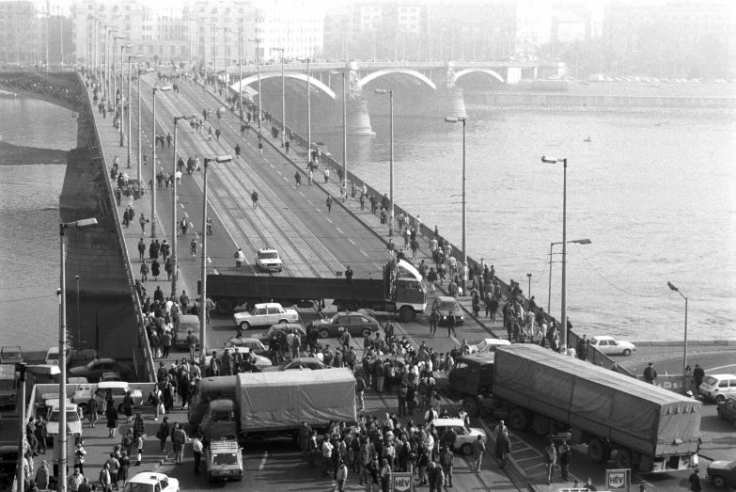
Rumors of a price increase had been circulating for weeks, but the government denied them in order to prevent panic buying. A significant proportion of citizens expressed their indignation at gas stations, but the representatives of the most affected profession, taxi drivers, went much further. The members of this large group of about 20,000 had above-average communication capabilities thanks to their CB radios, as mobile phones did not yet exist. They acted almost immediately: first they drove to the parliament building, and then – since the government did not withdraw the measure – on the evening of the 25th, they blocked key points in the city, all the bridgeheads in Budapest as well as major highway ramps, making car traffic impossible. Truck drivers also joined them. All this caused unexpected and enormous chaos throughout the country, and the supply of goods in the capital was also paralyzed. Nevertheless, many people expressed their solidarity with the taxi drivers, bringing tea, coffee, and food to the blockade builders.
All this happened at a time when the government’s popularity was already severely damaged. A few weeks earlier, local elections had been held, in which the SZDSZ – and Fidesz, which was allied with it in many municipalities – performed best in Budapest and other bigger cities. University and college students were also protesting against the government because the Ministry of Education had begun its austerity measures by cutting student allowances.
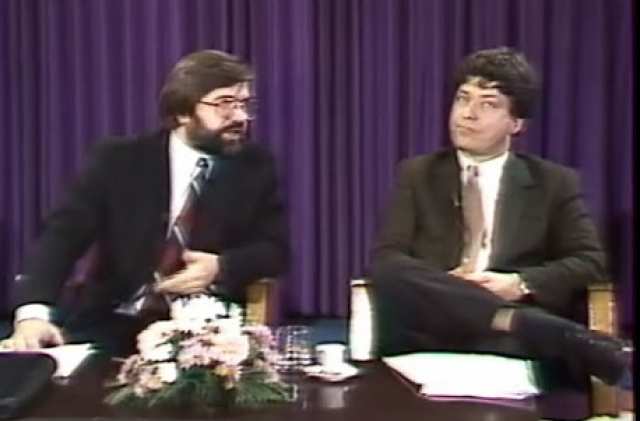
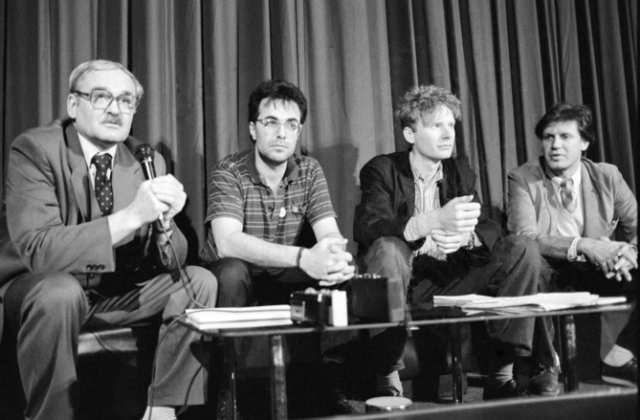
The largest opposition party immediately jumped on the bandwagon with the anti-government protest, which they viewed as a situation that could bring down the government through a comprehensive crisis of confidence,so they emphasised the government’s responsibility. Free Democrat politicians appeared at taxi ranks, while party leaders Iván Pető and János Kis declared that the failure to implement market reforms had worsened the conditions for economic crisis management and that the MDF-FKgP-KDNP government was unable to find a way out of the serious situation. The actions of the president, who came from the SZDSZ, also put pressure on the government: Árpád Göncz – going beyond his symbolic role as defined by the spirit of the constitution – stated that, as commander-in-chief of the armed forces, he would not allow the government to deploy army units to restore order. Sándor Barna, Budapest’s police chief, also preempted the interior minister’s call to use force to clear the roads. In this situation, Fidesz did not follow the SZDSZ and, although it sharply criticized the government after the crisis was resolved (“the government lied”) for its economic incompetence, it insisted that anti-government protests must remain within constitutional limits.
The government was forced into negotiations. As prime minister József Antall was in hospital, interior minister Balázs Horváth sat at the negotiating table. On Sunday, the MDF organized a pro-government demonstration, with marchers crossing two bridges blocked by taxis to arrive at the parliament, where an agreement was reached by Sunday evening. As a result, the price of gasoline was raised less than planned.
Pro-government politicians were understandably upset that a significant number of print media outlets had sympathized with the taxi drivers who had broken the law, that the police leadership did not clearly support them in a tense situation, and also that the SZDSZ behaved as it did. However, József Antall appeared before the cameras while in hospital and, in his so-called “pyjama interview,” described the events as an acceptable act of civil disobedience. His fundamentally self-critical statement won over the majority of the people, and following the agreement, order was restored in the country that same night.
Common past: knowledge to dispel historical misconceptions – supporting the work of Slovak and Hungarian history teachers through print and online publications, professional conferences. A project of the Association of History Teachers and the Hungarian-language newspaper of the Denník N news portal.
Funded by the European Union. The information and statements contained herein are those of the author(s) and do not necessarily reflect the official views of the European Union or the Tempus Public Foundation. Neither the European Union nor the funding authority can be held responsible for them.