

Claim:
In October 1918 Mihály Károlyi performed a quasi-coup, dishonestly making use of the shock caused by losing the war.
Rebuttal:
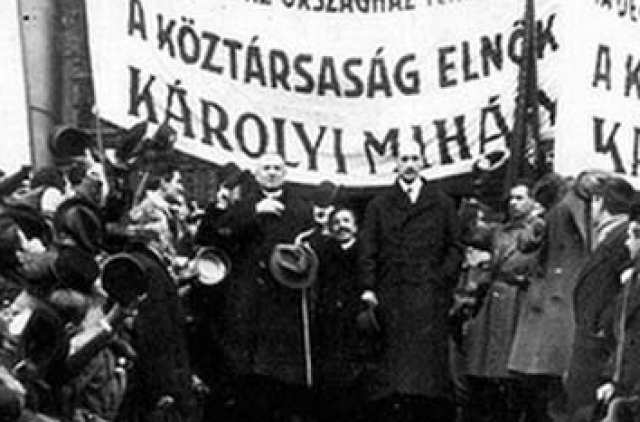
Károlyi was appointed prime minister at the pressure of the radicalising populace but with the support of decisive conservative politicians and following the proper legal procedure
In detail:
In late October 1918, on the brink of military collapse, it became obvious that the Hungarian elite, completely discredited during the war, must be replaced. The monarch, Charles IV talked to all the considerable politicians of the time, including Károlyi, and as a result he first appointed Count János Hadik as prime minister. Hadik meant to involve Károlyi in his government, but the events unfolded faster: the crowd radicalised by losing the war wanted Károlyi as a leader and the Hungarian National Council as the leading body. We can also add that a significant number of the political leaders (such as Ottokár Prohászka, Pál Teleki or István Tisza) were at this point all convinced that it was Károlyi and the Hungarian National Council that could maybe withhold the revolutionary impetus of the crowd and can be an acceptable negotiating party for the entente. As a result, Duke Joseph August as chief royal commissioner (’homo regius’) on 31 October 1918 apponited Károlyi as prime minister with the approval of Charles IV. Thus he was appointed in strict accordance with the required legal procedure.
It is true that Károlyi asked the monarch already the next day to release him and his government from the oath of allegiance to the throne. Charles was forced to do this partly by the revolutionary atmosphere in Hungary, partly by international pressure: it was more and more obvious that the entente powers would not gladly see the Habsburgs on the throne of Hungary. Acquiescing to the circumstances the monarch freed Károlyi from the oath. The question of what form of government the country should have was left oopen for the time being. It was only after Charles IV abdicated from the throne of Hungary on 13 November that the People’s Republic of Hungary was declared three days later.
Common past: knowledge to dispel historical misconceptions – supporting the work of Slovak and Hungarian history teachers through print and online publications, professional conferences. A project of the Association of History Teachers and the Hungarian-language newspaper of the Denník N news portal.
Funded by the European Union. The information and statements contained herein are those of the author(s) and do not necessarily reflect the official views of the European Union or the Tempus Public Foundation. Neither the European Union nor the funding authority can be held responsible for them.