


Claim: The terms of the peace treaty were forced on Hungary by background actors (mainly secret societies like Freemasons). Their aim was to dismantle the thousand-year-old Hungarian state and lay their hands on its natural and other resources.
Rebuttal: The treaty was the result of the interstate agreements made during WW1 and agreements with the minority communities of the Austro-Hungarian Monarchy. There were no secret societies involved in the process.
In detail:
The draft for the peace treaty prepared for Hungary at the Paris peace conference was in harmony with contemporary French geopolitical strategy. The French had realised that the Austro-Hungarian Monarchy is no longer able to perform its former stabilising role in Europe, so they wished to replace it with a set of smaller states. The plan was that these new-fangled states would be loyal supporters of France in the future since they owe their existence to it, while they can keep tabs on a disarmed Germany and can separate the Communist Soviet Russia from Western Europe.
The warring parties in WW1 would use many different tools hoping to weaken their opponents. These included the ’destabilising strategy’ targeting the ethnic minorities of the Austro-Hungarian Monarchy, which for example gave rise to Edvard Beneš’ pamphlet calling for the smashing into pieces of Austria-Hungary.
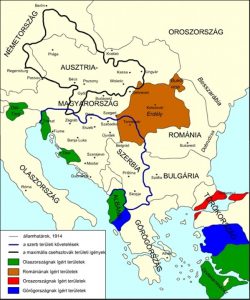
At the peace conference the Italian, British and American delegations initially suggested new borders for Hungary that would have corresponded to the Wilsonian principles much better, but their arguments were soon refuted in light of the secret treaties made during the war and the claims made by the Monarchy’s ethnic minorities based on strategic, economic and logistical reasons. For the US delegation the peace with Germany was the most important, so they left the conference as soon as that was accomplished in 1919, thus diminishing the number of participants sympathetic with the Hungarian cause.
Italy’s voice was heard to a lesser extent at the conference table than that of Britain or France, therefore they, ’the defeated victor’ left the conference fairly disappointed. The goal of Italy was to weaken the positions of the newly created Slavic state on the Balkans, Yugoslavia, so they were doing a precarious balancing act concerning the Hungarian-Romanian border. The latter, however, had been tied to the entente powers by a secret contract from during the war, so when it came to the final decision, they sided with them.
The Brits (not least as a result of the convincing arguments of the Hungarian delegation led by Albert Apponyi) even suggested that the draft be revoked for revision in the spring of 1920, but in the meantime the French gave up the Mosul vilayet to the British (with its substantial oil deposits), and this made for the quick resolution of the Hungarian question.
As these points illustrate, the decisions of the peace treaty were made on the basis of the geostrategic considerations of the great powers rather than the result of discussions in smoke-filled back rooms by secret societies.
The most often voiced claim is that the entire peace conference was orchestrated by a conspiracy of background power groups, where a leading role was played by the Freemasons. The authors and historians who support this view consider the Enlightenment to be the problem itself, whose harmful ideology shattered a once safe and well-oiled world order. The secret societies disseminating the views of the Enlightenment were allegedly instrumental in this process, with the Freemasons among them, who are credited with moving the strings in the background and eventually managed to dismantle the Austro-Hungarian Monarchy.
One problem with this theory is that it only looks at sources from before WW1, it doesn’t look at freemasons’ writings from during the war. Hungarian historian Balázs Ablonczy, however, has recently done this this job and looked through the materials of the Grand Orient Lodge seated in Paris found nothing to substantiate the above conspiracy theory. Moreover, he found that the behaviour of the freemason ’brethren’ was influenced more by a nationalist than an internationalist logic. In a war, that is, they would be more prone to represent the interests of their own respective countries than that of the freemason movement.
Negative feelings concerning freemasons are almost as old as the movement itself: during the 18th century it was mainly the church and the aristocracy, during the 19th century the members of the political elite, while in the 20th century it was the lower middle class, less and less trustful with state institutions, who saw freemasons as all source of evil. (See our earlier article on the subject: https://tenyleg.dev.appsters.me.appsters.me/2017/11/03/jakobinus-es-bolsevik-verzioju-szabadkomuvesseg/ )
References:
- Ablonczy Balázs: Száz év múlva lejár? Újabb Trianon-legendák. Budapest, 2022, Jaffa.
- Margaret Macmillan: Béketeremtők. Az 1919-es párizsi békekonferencia. Budapest, 2005, Gabo. Lásd még beszélgetés Ablonczy Balázzsal: https://www.youtube.com/watch?v=DBsd9pbmGRY
- Ablonczy Balázs: A magyar szabadkőművesek valóban lobbiztak, de éppenséggel Trianon ellen hvg.hu 2022. 08. 28. https://hvg.hu/360/202234__ablonczy_balazs_tortenesz__ujabb_trianonlegendakrol_csirke_farhatrol__torzult_emlekezet
- Ormos Mária: Padovától Trianonig – 1918-1920. Budapest, 2020.
- Romsics Ignác: A trianoni békeszerződés. Budapest, 2020, Helikon.
- Hahner Péter: 100 történelmi tévhit, avagy amit biztosan tudsz a történelemről – és mind rosszul tudod… Budapest, 2010, Animus.
- Christopher Hodapp – Alice von Kannon: Összeesküvés-elméletek & titkos társaságok. Budapest, 2015, Panem.
Common past: knowledge to dispel historical misconceptions – supporting the work of Slovak and Hungarian history teachers through print and online publications, professional conferences. A project of the Association of History Teachers and the Hungarian-language newspaper of the Denník N news portal.
Funded by the European Union. The information and statements contained herein are those of the author(s) and do not necessarily reflect the official views of the European Union or the Tempus Public Foundation. Neither the European Union nor the funding authority can be held responsible for them.