



Claim: Hungary was given a punishment in 1920 in Trianon unlike any other country has ever been given.
Rebuttal: There have been numerous peace treaties throughout human history where the defeated party had to suffer significant territorial losses. The annexation of Bosnia by the Austro-Hungarian Monarchy, for example, which was one of the events leading up to World War 1, involved the placing of millions of South Slavic people under the rule of another country without ever asking for their opinion.
In detail:
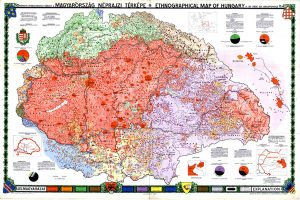
The Trianon peace treaty is doubtless one of the greatest traumas of modern-day Hungarian history. The 282 thousand square kilometre territory of Hungary shrank to 93 thousand, so it lost nearly two thirds. Out of its 18.2 million inhabitants merely 7.6 million remained in its newly established territory, so the population shrank to 43% of its original size. This involved 3.3 million Hungarian-speaking persons becoming the citizens of Czechoslovakia, Romania and Yugoslavia. Hungary also had to hand over a significant part of its natural resources and much of its railway network. Family ties were severed, and a lot of towns that had a significant role in national historic memory found themselves in neighbouring countries, such as Bratislava (Pozsony), Košice (Kassa), Oradea (Nagyvárad), Alba Iulia (Gyulafehérvár), Cluj (Kolozsvár) and Timisoara (Temesvár), etc.
This loss proved to be decisive for the 20th century history of Hungary and we still feel its repercussions. But was this loss indeed unprecedented in world history and there has been nothing comparable ever since? Is it indeed true that ’never ever has another country undergone’ a punishment of similar scope and severity?
It is a fact that among the peace agreements closing WW1 the one concerning Hungary must have been the most controversial. Yet it is not useful to aggrandise a national trauma by belittling the traumas of other nations.
Poland has been partitioned several times throughout its history, including periods when it was wiped off the map entirely. In 1772 it lost 29% of its territory and 4 million of its 14 million citizens. Two decades later half of Poland’s remaining territory and population was taken away by neighbouring great powers. In 1939 the Third Reich and the Soviet Union divided up Poland and they went on to occupy it. After WW2 Polands borders were moved to the west and it had to undergo a very significant population transfer.
The peace treaty of Guadalupe Hidalgo of 2 February 1848, which closed the US-Mexican war, worked very similarly to the treaty of Trianon. The United States managed to get Mexico to give up 1.37 million square kilometres, 55%, of its territory. Arguably this loss was less significant for Mexico than losing for example Transylvania was for Hungary, but the US-Mexico border created here has been a source of problems for the two states to this day.
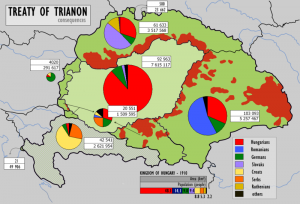
When making any sort of comparisons, it is misleading to look at only the size of ceded territories. Painful as it is to admit, it is a fact that the Hungarian ethnic group was a minority in the territories ceded to neighbouring countries. Within these regions there were obviously smaller areas, often near the new borders, where there was a Hungarian majority or even an exclusively Hungarian population. As for the partition of Poland – the territories it ceded to Prussia and the Habsburg empire were ethnically Polish.
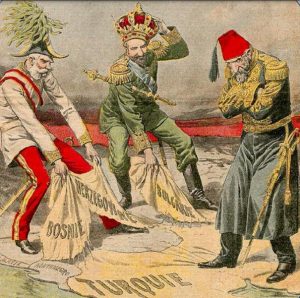
The annexation of Bosnia-Herzegovina by the Habsburg empire in 1908 was a very similar scenario. Those living there were mostly inclined to join a neighbouring Slavic country, namely Serbia, but the leaders of the Austro-Hungarian Monarchy, including the Hungarian leaders, considered this to be unfavourable for them and instead decided on the annexation of the territory. Moreover, in 1918, not long before the end of WW1, the Hungarian government actually designed the would-be new coat of arms of a Bosnia that would become part of Hungary. Just as the Hungarian individuals, families and communities were seriously hurt and damaged by the unfair peace treaty of 1920, the South Slavic people involved in the 1908 annexation were no less pained. It might not be pure coincidence that it was an assassination in the Bosnian capital Sarajevo that sped up the processes which eventually led to Trianon.
Apart from the tragedies playing out on the level of individuals and families, a long-term negative effect of Trianon is certainly the lasting ethnic-based distrust that it created among the peoples of the Carpathian basin. Apart from Czechoslovakia all the countries involved ended up building some kind of authoritarian regime, while their economy was extremely vulnerable, marking them out as easy prey for Fascist Germany.
References:
Hahner Péter: Legújabb 100 történelmi tévhit, avagy amit biztosan tudsz a történelemről – és mind rosszul tudod… Budapest, 2015, Animus.
Common past: knowledge to dispel historical misconceptions – supporting the work of Slovak and Hungarian history teachers through print and online publications, professional conferences. A project of the Association of History Teachers and the Hungarian-language newspaper of the Denník N news portal.
Funded by the European Union. The information and statements contained herein are those of the author(s) and do not necessarily reflect the official views of the European Union or the Tempus Public Foundation. Neither the European Union nor the funding authority can be held responsible for them.