


Claim:
The names of the two mythical heroes Hunor and Magor prove the relatedness of the Magyars and the Huns.
Rebuttal:
The legend of the magic deer, which is the source of the claim, probably stems from folk traditions and originally refers to a strong relationship between the Magyar and the Onogur peoples. It was only transformed into a ’proof’ of Hun and Magyar relatedness by medieval chronicler Simon Kézai.
In detail:
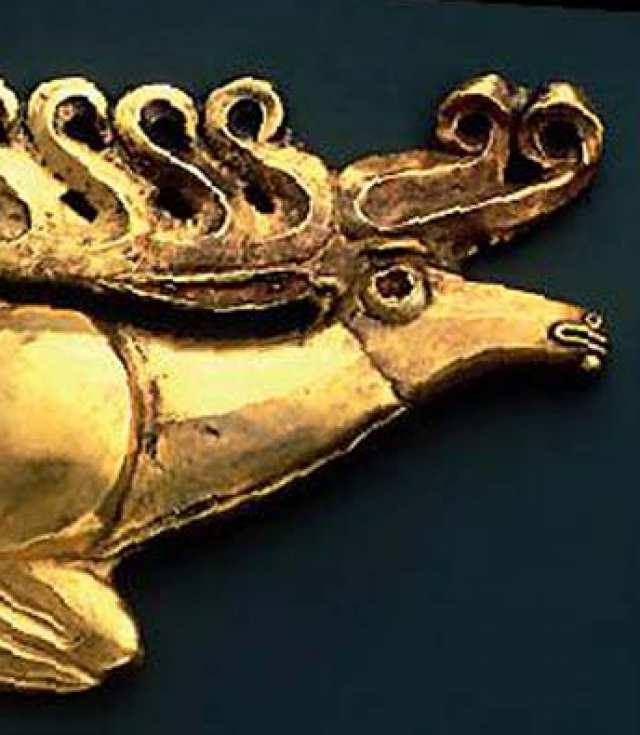
The Legend of the Magic Deer was written down in detail by Kézai, but earlier chronicles might have contained it too. According to the tradition of the chronicles of the time, this is how the story goes: the deer led the two brothers pursuing it into the swamps of Meiotis, the Azov Sea. This region was a neighbour of Persia, so if the Magyars went out to the steppe near them, they must have arrived in the territory owned by a certain Belár, where they found the wives of Belár’s sons without their husbands, with the two daughters of the High King of the Alans among them. They abducted the women and made them their wives, thus giving rise to both the Hun and the Magyar people, who got named after the founding fathers, Hunor and Magor.
A very similar legend features in a very similar version in the work of Jordanes, who claims it is the origin myth of the Huns. Kézai was familiar with the works of this Gothic chronicler, but most probably took the legend of the deer not from him but from Magyar folk tradition. We assume this because the story contains some elements that can’t come from the western tradition: mentioning Belár, that is the Bolgars, and the names Hunor and Magor, which preserve actual names of ethnic groups. Magor is probably a variant of the word Magyar indeed, while Hunor was probably Onur originally, and it comes from the name of the Onogur people, who were very strongly affiliated with the Magyars before the latter came to the Carpathian basin. This word gave rise to the name Magyars got to be referred to in other countries throughout Europe, ungar, hungarus, etc. Which is to say, the legend preserved the memory not of a Magyar-Hun but a Magyar-Onogur alliance and the name Hunor was actually made up by Kézai himself, to make it more suitable to the tale of Magyar-Hun alliance he wanted to tell.
The legend of the two brothers in pursuit of a magic deer might have been known to the Magyars even before their arrival in the Carpathian basin, as it was widespread across Eurasia. It was known to the Iranians, the Huns, the Turks, the Mongols, the Lapp and the Voguls. The component of the narrative where the two brothers become the ancestors of two closely related peoples can be found in the mythology of other Finno-Ugric peoples as well as among Turkic peoples.
So to sum up: Kézai took the legend of the brothers finding a new homeland pursuing a deer from contemporary folk tradition, but it was he who turned this story into an alleged proof of Hun-Magyar relatedness. Previously the legend was preserved in folk memory as a reflection of the emergence of the Magyar and Onogur peoples.
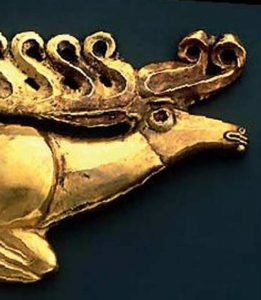
Scythian golden deer shield ornament found at the eastern side of the Black Sea (7-6th century BC)
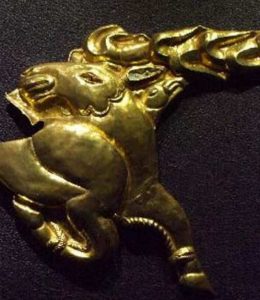
Scythian golden deer shield ornament from Zöldhalompuszta, Hungary (7-6th century BC)
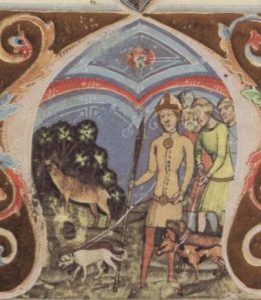
The depiction of the magic deer legend in the Chronicon Pictum (14th century AD)
Common past: knowledge to dispel historical misconceptions – supporting the work of Slovak and Hungarian history teachers through print and online publications, professional conferences. A project of the Association of History Teachers and the Hungarian-language newspaper of the Denník N news portal.
Funded by the European Union. The information and statements contained herein are those of the author(s) and do not necessarily reflect the official views of the European Union or the Tempus Public Foundation. Neither the European Union nor the funding authority can be held responsible for them.